Why Use LED Grow Lights?
Indoor light isn’t always enough, especially in:
- North-facing rooms
- Winter months
- Rooms with deep shadows
- Homes with few windows
LED grow lights give plants the right kind of light they need to make food and grow well — even when sunlight is limited.
Why Use LED Grow Lights?
✔ LEDs provide light plants can use for photosynthesis
✔ They are energy efficient and run cool
✔ They don’t overheat or scorch leaves
✔ They last a long time (often 25,000+ hours)
✔ You can grow plants in low-light rooms
LEDs are now the best choice for home plant lighting.
What to Look for When Buying LEDs
1. Light Spectrum
Plants need both blue and red light:
- Blue light (400–500 nm) helps leaf and stem growth
- Red light (600–700 nm) helps flowering and fruiting
Look for:
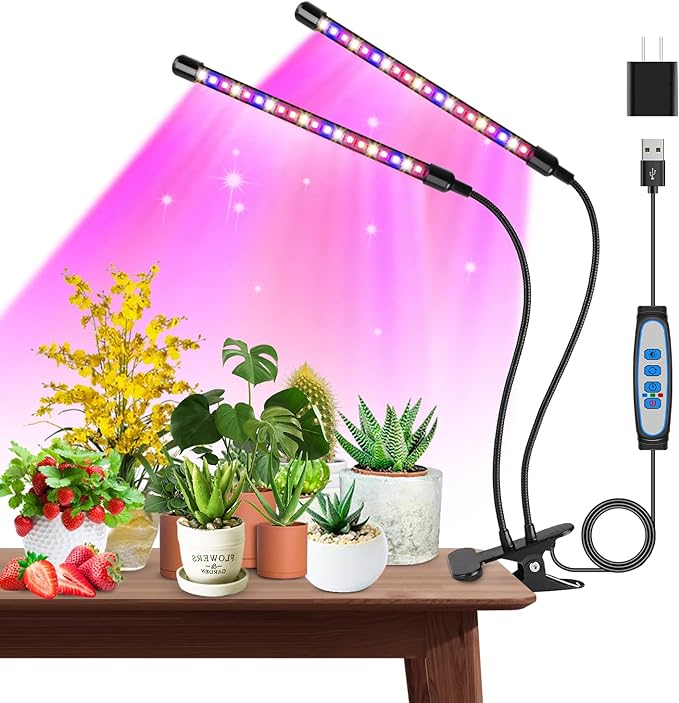
- Full-spectrum LED grow lights — these provide a mix of blue, red, and sometimes white light that’s great for most house plants.
Avoid lights that are only red or only blue — they may work for some plants but aren’t balanced for general house plant growth.
2. Brightness (PPFD / PAR)
Plants respond to the light they can use, not just how bright it looks to our eyes.
- PAR and PPFD are technical terms that tell you how much usable light the plants receive.
- For most house plants, aim for 150–300 µmol/m²/s at the canopy.
- For leafy plants: 150–250
- For flowering/fruiting plants: 250–350
If the product doesn’t list PPFD or PAR, check the wattage and size of the coverage area (see next section). Higher wattage generally means stronger light.
3. Coverage Area
Match the light to the space you want to light:
| Space | Ideal Light Type |
|---|---|
| Small single plant | Clip-on or desktop LED |
| Medium shelf or grouping | Panel light 30–60 cm wide |
| Large shelf or growing table | Larger panel or multiple lights |
| Hanging baskets or many plants | Adjustable light bar or rails |
Tip: Always check the manufacturer’s coverage chart — it tells you how far apart lights should be and how much area they cover.
4. Adjustable Height & Timing
Good features to look for:
- Adjustable height — light can be lowered as plants grow
- Built-in timer — set on/off automatically
- Dimmable — adjust brightness as needed
Most house plants need 12–14 hours of light per day with a daily “dark period” — just like nature.
5. Energy Use & Heat
LEDs are efficient — they use less power and stay cool.
Check:
- Wattage (e.g., 20 W, 40 W) — more watts usually means more light
- Heat output — LEDs run cooler than other types
Cool lights are safer near leaves and furniture.
How to Use LED Lights with House Plants
Placement
- Keep lights 15–45 cm (6–18 inches) above plants
- Brighter plants (succulents) need closer light
- Shade-tolerant plants can be farther away
Timing
- 12–14 hours of light daily
- Turn off at night — plants need a dark period too
Mixing with Natural Light
- Use LEDs to supplement sunlight
- In bright rooms, LED hours can be shorter
- In low light rooms, LEDs may be the main source of light
Quick Buying Checklist
✅ Full spectrum (blue + red)
✅ Good PAR/PPFD rating
✅ Right coverage area
✅ Adjustable height or hanging kit
✅ Timer or dimmer built-in
✅ Efficient power use
Plants That Benefit Most from LED Lights
All house plants — especially:
- Low-light tropicals (e.g., snake plant, peace lily)
- Flowering plants (help them bloom indoors)
- Seedlings & cuttings
- Shelves or rooms with no direct sun
Sproot Top Tip
LED lights don’t replace good placement — combining natural light with LEDs makes plants happiest. Use the light to fill gaps, not just as a replacement for all daylight.